
What Portage County Property Tax Records Can Show
Portage County splits its tax data across two systems. The Real Estate Tax Parcel / Property Listing portal covers parcel and assessment details. The Treasurer's tax inquiry handles bills, payments, and balances. The county also manages delinquent real-estate taxes, tax foreclosures, unclaimed funds, and lottery-credit information. Some parcel-result details only appear in the live system. A value without its assessment year can mislead. And remember, the Treasurer's bill answers a different question than the assessor's parcel record does.
| Field | What It Shows | Where |
|---|---|---|
| Parcel and assessment record | Parcel and tax information; confirm exact value fields and year in the live card | Real Estate Tax Parcel portal |
| Current tax bill | Bill and payment information | Treasurer tax inquiry |
| Delinquent tax | Current or prior-year amount due and status | Treasurer |
| Tax foreclosure | County foreclosure-sale records and related notices | Treasurer |
| Lottery tax credit | Credit information and processing guidance | Treasurer |
| Equalized value | Municipal comparison measure | Wisconsin Department of Revenue |
Wisconsin assessed value is assigned for taxation as of January 1 and applied to taxes levied at the end of that year. Equalized value is calculated by the state to compare local values. The bill reflects the tax obligation and credits for its tax period; it is not a fresh appraisal or a reliable estimate of the next sale price.
Portage County Tax Searches and Parcel ID Formatting
The county navigation sheet lists the parcel format as 999-99-9999:01.01 and directs you to drop the first two dashes before searching online. Enter 999999999:01.01, keeping the colon and decimal. Save the original format too. It still has to match a deed or a GIS map. No parcel number? Clear the form and search by municipality plus street number, a fallback the county itself endorses.
Never guess the taxing municipality from the postal city in an address. Portage County holds one city, nine villages, and seventeen towns. Four of those towns collect their own first installments. If an account looks unclear, use the municipality selector or ask the Treasurer. Open the Portage County Real Estate Tax Parcel portal to begin the parcel lookup.
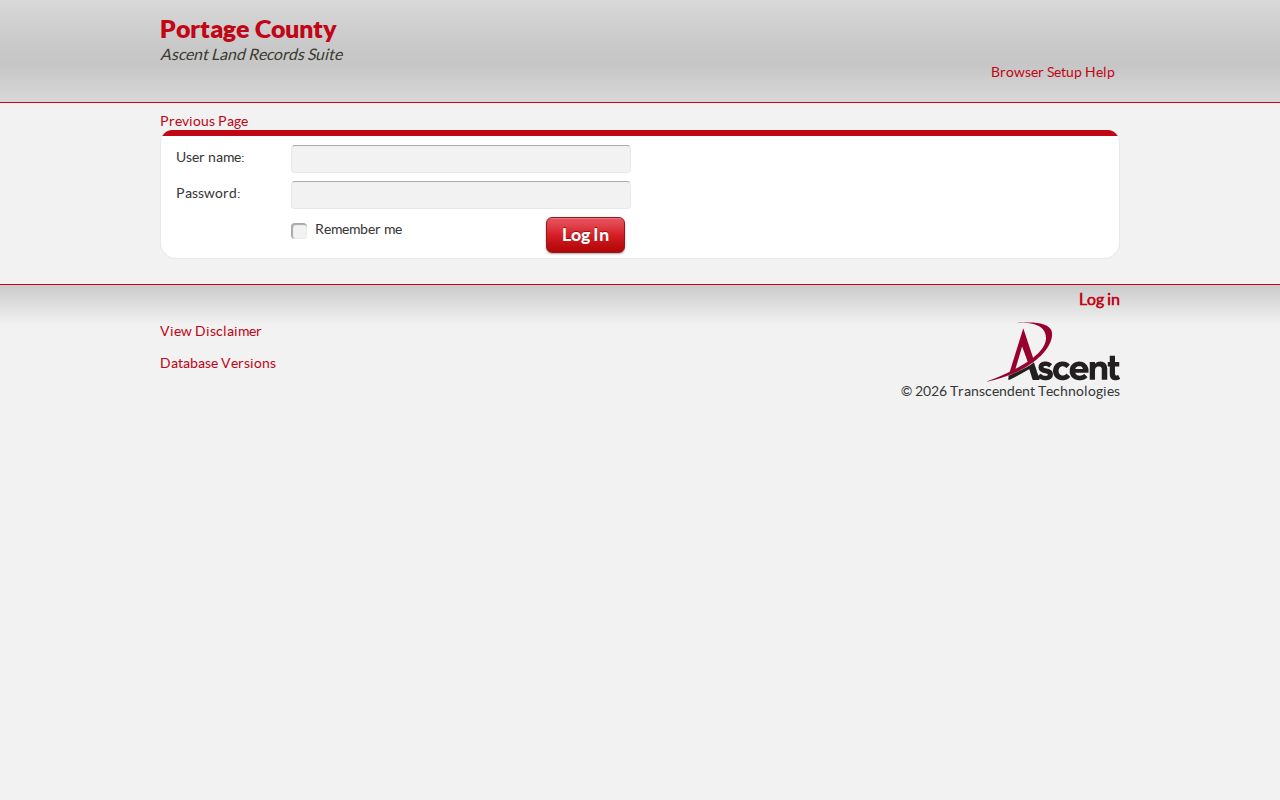
Portage County Tax Searches and Parcel ID FormattingThe county's parcel-search entry point is where lookups begin. Year-specific assessment and account details appear in the live results.
Using the Portage County Treasurer's Tax Inquiry
The Treasurer's online tax inquiry page is the route for viewing a bill and paying it. County instructions call for Chrome or Edge. Pop-up blocking may need to be disabled. If a payment window will not open, figure out whether it is a browser problem or a missing tax account. The office sits at 1516 Church Street, Stevens Point, WI 54481, and answers the phone at 715-346-1348, Monday through Friday, 7:30 a.m. to 4:30 p.m.
Payment convenience fees are $3.95 for Visa debit, 2.39 percent for credit or non-Visa debit, and $1.50 for e-check. The fee covers the online transaction, not the public-record search. Confirm the current amount and accepted methods on the live payment page before submitting money.
Use the Treasurer's tax inquiry and payment page for its instructions.
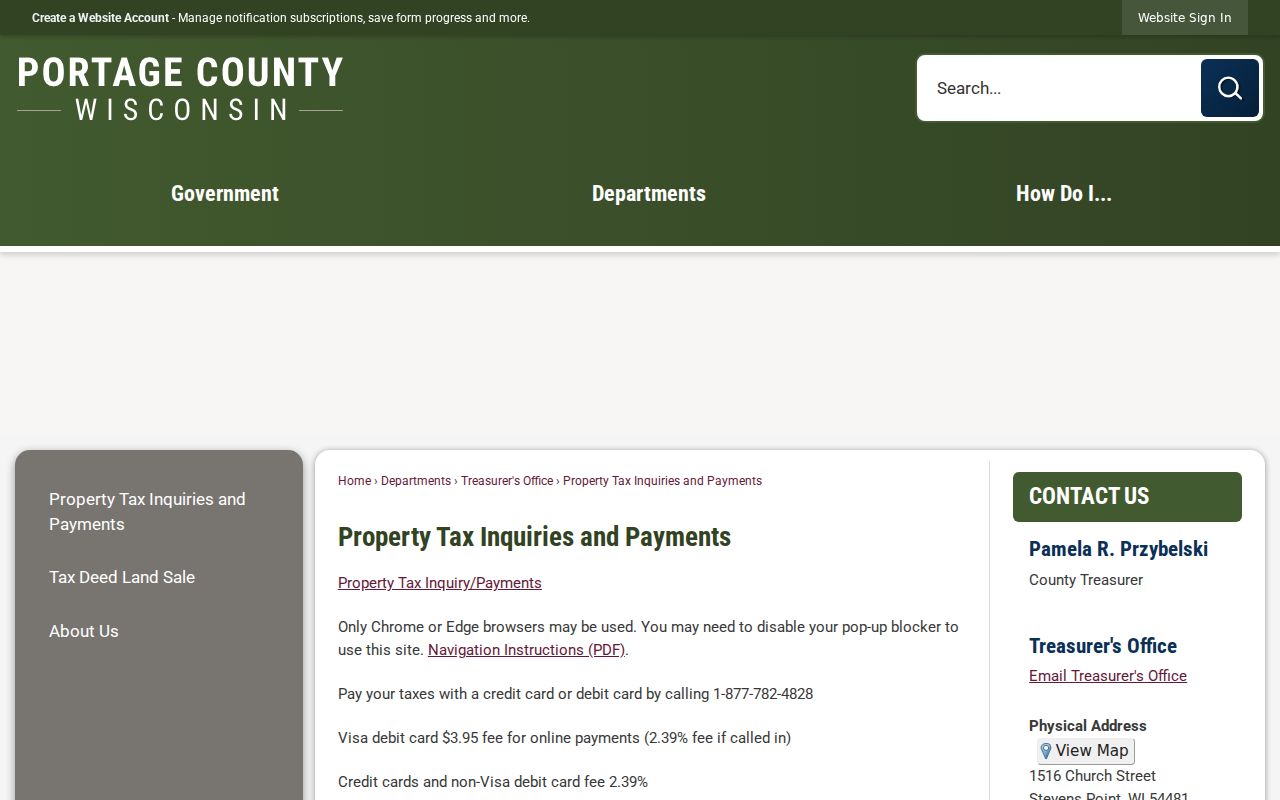
Using the Portage County Treasurer's Tax InquiryThe landing page links directly into the bill and payment system. A bill copy is still a tax record, not a deed.
Four Portage County Towns Collect the First Installment
Almond, Belmont, Eau Pleine, and Lanark collect their own first real-estate tax installments. That local exception trips up taxpayers who expect one county payment destination. Before calling a payment late, check the municipality printed on the bill. Follow the collection instructions for that parcel. Nothing is duplicated that way. The county Treasurer remains the main source for current and delinquent county tax records. That first collection step can belong to a town.
This is why a municipality search often beats an address alone. A postal place name does not guarantee the taxing jurisdiction matches. Keep the parcel identifier, tax year, and municipality together. Either office may need them to locate an account.
How to Find a Portage County Tax Bill
Search the Treasurer's inquiry by parcel. Or use the address fallback from the county navigation sheet. Match the result to the right municipality and tax year before judging payment status. For the current owner or assessment field, cross-check the county parcel listing. Prior-year taxes send you back to the county Treasurer. This holds even through the city's Stevens Point portal. The tax site gives an account view and a payment path. The Register of Deeds records the instruments that transfer property.
- Enter the parcel ID in the portal's normalized format or use municipality plus street number.
- Confirm the tax year and municipality before reading the account.
- Review the bill and payment information, then note any prior-year balance.
- Contact the Treasurer about delinquency or foreclosure records that need explanation.
- Assessed value
- The municipality's January 1 value used for that year's tax process.
- Equalized value
- The state's comparison value for municipal assessment levels.
- Lottery tax credit
- A Wisconsin tax credit with its own eligibility and processing rules.
- Delinquent tax
- An amount due after the payment period; check the Treasurer's current account status.
Portage County Tax Credits and Delinquent Records
The Treasurer's Office tracks lottery tax credits alongside current and delinquent tax accounts in Portage County. A credit lowers the tax bill. It never proves occupancy or ownership. For the credit question, follow the tax account instructions; for legal ownership, rely on the recorded deed. Foreclosure-sale information sits in a separate source. A delinquent balance by itself does not establish that a foreclosure has occurred.
A parcel with arrears raises several questions. Which tax year and installment does the balance cover? Did the collecting office receive a payment? Does a foreclosure record exist? Request the specific bill or notice by parcel number and year, and if nothing is posted online, Wisconsin Public Records Law offers a request route subject to exceptions and allowed copy or search costs.
Portage County points property owners to its Treasurer's Office information as the source for delinquency, foreclosure, unclaimed funds, and credit details.
Portage County Assessed, Equalized and Market Values
Wisconsin uses assessed value and equalized value for different purposes. Assessed value is assigned for taxation as of January 1 and applied to taxes levied at the end of that year. Equalized value is a Department of Revenue calculation used to compare municipal values. Market value is an estimate of what property may sell for under relevant conditions. A tax bill combines taxable value, local rates and credits; it is not a sale record or a private appraisal.
Do not mix an individual assessment ratio with a municipal assessment level. The individual ratio is assessed value divided by fair market value. The assessment level is the municipality's total assessed value divided by equalized value. They answer different questions. A county card may show a local assessment, while DOR reports supply statewide definitions and municipal comparisons.
The DOR Wisconsin property-owner guide explains these value terms.
Wisconsin's 2026 Ratio Reports and Portage County Taxes
On March 24, 2026, the Wisconsin Department of Revenue posted its final 2025 sales reports. These estimates feed the January 1, 2026 assessment level. The reports draw on assessor-submitted Property Assessment Data. That dataset is not a complete sales list. The system automatically rejects gifts, exempt or partial-interest transfers, and certain non-arm's-length transactions. For a broader sale source, DOR points to electronic Real Estate Transfer Returns.
Each question has its own record. Use the tax bill for an amount due, the parcel record for a local assessment, a recorded transfer for a filed transaction, and DOR reports for ratio analysis. One number should never stand in for another. The 2026 DOR notice also explains how the 2025 sales data informs 2026 assessment levels.
Questioning a Portage County Assessment
An assessment challenge starts with the notice. Read it alongside the local assessor's instructions on how to request a review. Portage County sets no single appeal deadline. Board schedules, deadlines, and forms vary by municipality and by the notice itself. Check the notice for your parcel. Contact the assessing office it names, and ask which local review step applies before submitting evidence.
Match the evidence to the issue. Compare similar land and building characteristics, confirm the parcel boundary and legal description, and keep the assessment year apart from a later sale. A recorded transfer can serve as one reference. DOR's rejected-sale rules still apply. They show why a price alone may not establish market value, so rely on the official review process and a qualified valuation professional for a contested amount.
Check the local notice. Portage County research did not verify a single countywide filing deadline or appeal board schedule. Read the notice for the specific municipality and confirm dates with its assessor before acting.